
Most crypto does not sit still, and when someone is trying to hide it, it does not stay on one network either. That single habit is where a lot of tracing tools quietly run out of road, which makes it the fairest test to put any of them through. This FinTracer review looks at the platform through exactly that test. Not how it reads one tidy chain, but what it does when funds refuse to stay on one. That is the harder question, and the more honest one.
The handoff that breaks most trails
A trace starts from something small. Usually one wallet address, or a hash from a transaction you already hold. The trouble begins the moment that money crosses from one network to another. The path appears to snap. The trail looks dead. What lands on the far side wears a new address and often a different token, so to the eye the original sum simply vanishes and something unrelated turns up in its place.
FinTracer is built to carry the trail across that crossing. Where the hop happens on-chain, through a bridge, it links the two sides, so a route over several networks reads as a single path. Where the funds move through a centralised service instead, no on-chain tool can see across the gap, and the platform says as much plainly rather than guessing past it.
Following a single chain is easy enough. A patient person manages it with a public explorer and a free afternoon. Once the money starts moving between networks, that stops being realistic, and a dedicated tool starts to matter.
Pictures instead of hashes
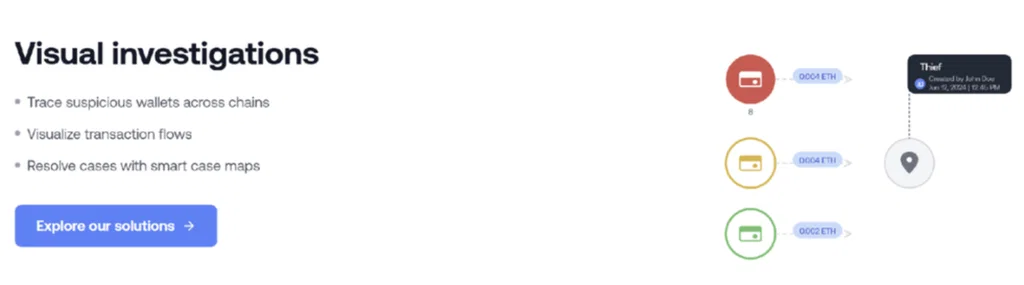
The output is a visual flow. Wallets become points, movement becomes lines, and each crossing shows up as a join between one network and the next. On a trail that touches three or four networks, that picture is the whole difference between keeping your place and losing it. Of everything tested for this FinTracer review, the mapping did the most work, and it is the part hardest to reproduce by hand.
Flags where they count
Knowing where money travelled is only half the work.
FinTracer also grades what the money moves through, marking mixers, high-risk services and addresses linked to known trouble by the level of risk they carry, so the parts that deserve attention are the ones that stand out.
A route that runs clean through ordinary wallets tells a very different story from one that ducks through a mixer on its way. FinTracer draws that line for you. Better still, it draws the line while the trail is still being built, rather than leaving you to spot the problem long after the fact.
Access and support
There is almost nothing to set up. FinTracer studies activity without ever holding it, so no account tiers need weighing and no balance needs funding before a first trace. The opening session is short by design.
Support and onboarding are the weaker corner. The deeper analytics reward a bit of blockchain fluency, and anyone arriving cold will spend a while learning what each flag is telling them. A guided first run would help. Wider user impressions are collected on the FinTracer review listing at ReviewCharts.
The verdict
The strengths and the shortcomings point at the same person. FinTracer is at its sharpest when a trail is genuinely knotted, across chains, through services, several hops from where it began, which is exactly the kind of trail that leaves a manual search stranded almost as soon as it crosses the first network.
For a single clean transfer you could have followed yourself, it is overkill. Hand it a real tangle, though, and it holds the thread precisely where lighter tools let go. For anyone tracing lost crypto, or mapping a route that will not sit still, this FinTracer review rates it a focused, capable platform that does the hard part well.