Introduction
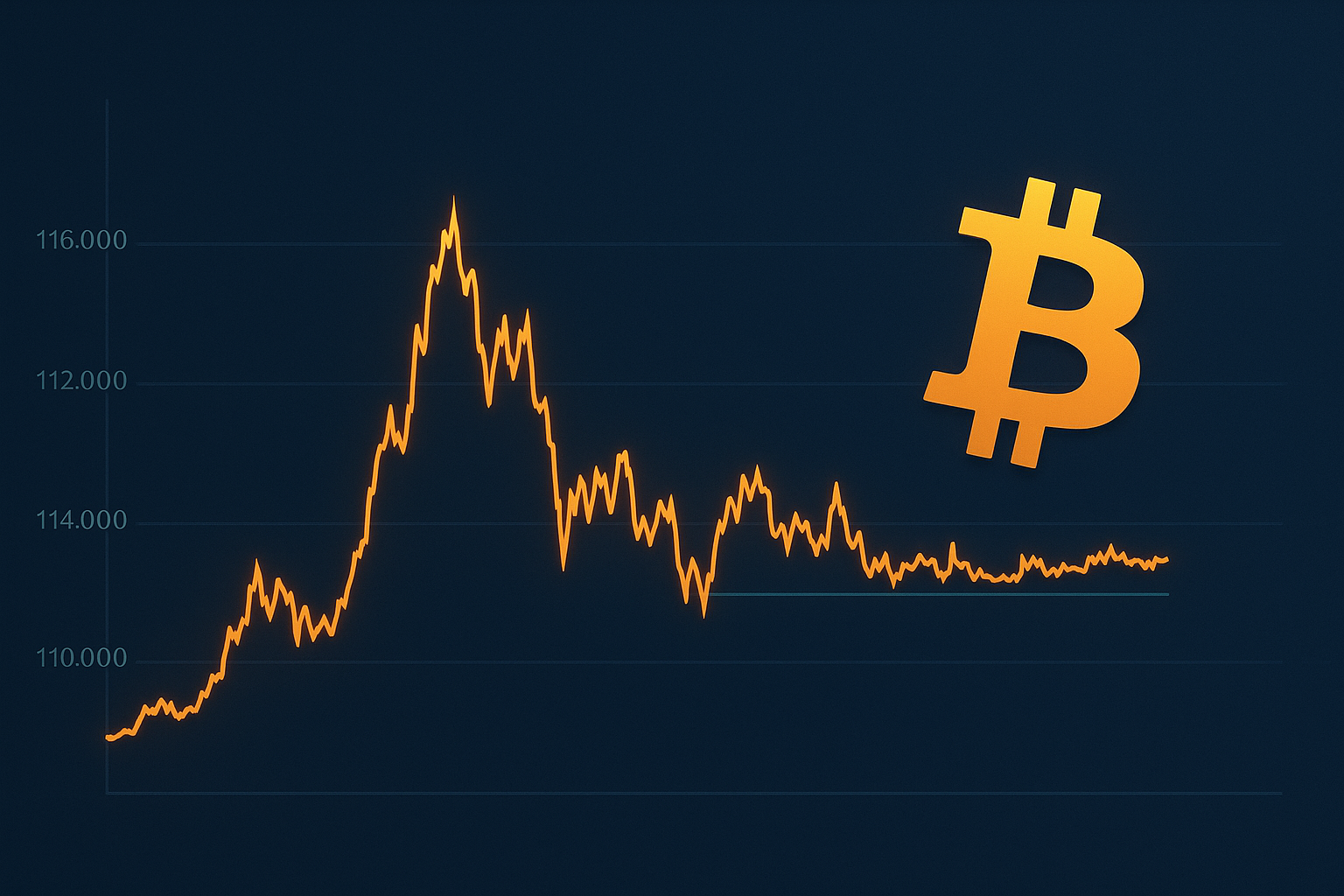
Bitcoin, the world’s largest cryptocurrency, has entered a consolidation phase, hovering near the 113,000 to 114,500 USD range after briefly touching 115,000 USD. This pause comes at a crucial moment as global traders and investors await the outcome of the upcoming Federal Open Market Committee (FOMC) meeting. The event is expected to shape the direction of global liquidity and interest rates — two key variables that directly impact cryptocurrencies.
As the crypto market steadies itself, many are viewing this as a temporary pause before the next major move. Bitcoin’s stability contrasts sharply with the weakness seen across the altcoin market, highlighting a shift in risk appetite and investor sentiment. This article examines Bitcoin’s recent price behaviour, the role of institutional flows, macroeconomic factors, and technical levels to watch in the days ahead.
Market Overview: Bitcoin’s Calm Amid Market Pullback
In the past 24 hours, Bitcoin slipped by around 1.4 percent to approximately 113,800 USD, retreating slightly from its 115,000 USD high. Ethereum followed suit with a 3.5 percent decline to nearly 4,100 USD. Major altcoins such as BNB, Solana, XRP, Dogecoin, Tron, and Cardano recorded losses between 4 and 6 percent.
The global cryptocurrency market capitalization also fell by roughly 1.3 percent to 3.84 trillion USD, reflecting a mild risk-off sentiment across digital assets. However, Bitcoin’s relative stability compared to other tokens suggests that investors are shifting their focus toward the leading digital asset — often considered the “safe haven” within crypto during uncertain times.
Why Bitcoin Is Consolidating: The Role Of The FOMC And Macro Factors
The FOMC’s Influence
The key factor behind Bitcoin’s current consolidation is the upcoming FOMC meeting. The Federal Reserve’s monetary policy decisions, particularly around interest rates, have a direct influence on global liquidity conditions. Lower interest rates or dovish guidance generally encourage risk-taking, while higher rates tighten financial conditions and can pressure risk assets like Bitcoin.
At present, markets are unsure whether the Fed will signal a rate cut or maintain a cautious stance. This uncertainty has led traders to scale back leverage and reduce exposure, resulting in a narrower trading range for Bitcoin. The consolidation phase may therefore be more a reflection of patience than weakness.
Institutional Inflows and Market Support
Despite retail traders’ cautious approach, institutional investors continue to show strong interest in Bitcoin. Weekly net inflows into crypto investment products recently reached around 900 million USD, signaling renewed confidence from professional money managers. In addition, several corporate treasuries have resumed Bitcoin accumulation, with one firm reportedly purchasing more than 40 million USD worth of BTC to add to its balance sheet.
This ongoing accumulation provides a stabilizing force for Bitcoin’s price. Institutional demand tends to focus primarily on Bitcoin and Ethereum, which explains why these two assets often perform better during market slowdowns compared to smaller-cap altcoins.
Global Economic Tailwinds
Another supportive factor is the broader economic backdrop. Progress in trade negotiations between major economies and a softer U.S. dollar have created an environment conducive to risk assets. A weaker dollar typically strengthens Bitcoin’s appeal as an alternative store of value. At the same time, geopolitical stability and improved trade relations could ease investor fears, encouraging long-term positioning in Bitcoin.
Technical Analysis: Key Levels To Watch
Bitcoin’s current chart structure reflects a period of consolidation, with clearly defined support and resistance zones. The upper resistance is seen near 116,900 USD, a level that has capped recent rallies. On the downside, strong support lies around 111,400 USD.
A breakout above resistance could pave the way for a move toward 120,000 USD, while a breakdown below support might trigger a test of the 108,000 USD region. Technical indicators suggest a balanced market — neither overbought nor oversold — with declining volatility hinting at a potential buildup before a significant directional move.
The stability around 114,000 USD indicates that Bitcoin is finding equilibrium between buying and selling pressure. Such consolidation phases often precede strong breakouts once a fundamental or technical catalyst emerges. Traders are closely monitoring the FOMC meeting for that trigger.
Altcoins Under Pressure: Diverging Performance Explained
While Bitcoin remains relatively stable, the altcoin market has faced a sharper pullback. There are several reasons for this divergence:
Liquidity Rotation to Bitcoin
During uncertain macro periods, capital tends to flow from smaller, riskier assets to larger, more established ones. Bitcoin benefits from this “flight to quality” as it offers deeper liquidity and greater institutional adoption.
Speculative Position Unwinding
Many altcoins experienced rapid gains in prior weeks, fueled by speculative trading and leverage. As traders reduce risk exposure ahead of key events like the FOMC meeting, these assets tend to experience sharper corrections.
Institutional Focus on Blue Chips
Institutional investors prefer Bitcoin and Ethereum due to regulatory clarity and high liquidity. This results in sustained inflows into these assets even as broader crypto sentiment weakens.
Technical Fragility
Many altcoins lack strong support zones and have thinner order books, which amplifies volatility when selling pressure increases.
This divergence underscores how Bitcoin continues to act as the market’s anchor. In times of macro uncertainty, it often outperforms the broader crypto complex, reaffirming its position as the dominant store of value within the digital asset ecosystem.
Trader Sentiment And Strategy Insights
For Short-Term Traders
Bitcoin’s range-bound behaviour between 111,400 USD and 116,900 USD offers both challenges and opportunities. Traders may look to play this range until a decisive breakout occurs.
A move above 116,900 USD with strong volume could open a path toward 120,000 USD and beyond.
A breakdown below 111,400 USD could lead to a short-term correction toward 108,000 USD or even lower support levels.
Keeping position sizes moderate and stops tight is advisable given the potential for volatility after the FOMC meeting.
Altcoins, on the other hand, may remain volatile and less predictable until Bitcoin establishes a clear direction. Short-term traders might prefer focusing on BTC or ETH for stability and liquidity.
For Long-Term Investors
For investors with a longer time horizon, Bitcoin’s current consolidation should be seen as a constructive phase. The fact that prices are holding above 110,000 USD despite macro uncertainty and broader market weakness reflects underlying strength. Institutional participation and increasing adoption across corporate and national levels provide long-term tailwinds.
Investors may consider this period as an opportunity for gradual accumulation rather than aggressive buying. Maintaining a diversified approach — focusing on Bitcoin and major Layer-1 projects with proven use cases — remains a prudent strategy.
Risk Factors to Consider
If the Federal Reserve signals a prolonged period of high rates, liquidity could tighten and pressure all risk assets.
Broader economic shocks or equity market sell-offs may spill over into crypto markets.
Technical breakdowns below key support levels could trigger stop-loss cascades, especially in leveraged altcoin positions.
Risk management remains essential, particularly in a market where sentiment can shift rapidly.
Broader Implications For The Crypto Market
Bitcoin’s consolidation phase is not an isolated event; it mirrors the broader environment of cautious optimism in global markets. Several implications arise from this:
Crypto Maturity
The fact that Bitcoin can hold steady amid global uncertainty highlights its growing maturity as an asset class. Volatility remains high compared to traditional markets, but the degree of stability around major events like the FOMC is improving.
Institutional Confidence
The return of institutional inflows suggests that Bitcoin is increasingly being viewed as a strategic long-term asset rather than a speculative trade. This could gradually reduce volatility and attract more conservative investors.
Altcoin Market Reassessment
The underperformance of altcoins might lead to a reevaluation of which projects have real value versus those driven by hype. This differentiation could strengthen the market’s overall health over time.
Global Monetary Policy Link
Bitcoin’s reaction to macroeconomic factors underscores its integration with global financial systems. It is no longer a fringe asset; rather, it behaves increasingly like a high-beta risk asset, influenced by the same liquidity and policy cycles that affect equities and commodities.
Outlook: What Comes Next For Bitcoin?
As the FOMC meeting approaches, Bitcoin’s near-term direction will likely hinge on the tone of the Federal Reserve’s commentary.
If the Fed adopts a dovish stance, signaling potential rate cuts or flexibility, Bitcoin could break above resistance and move toward 120,000 USD or higher.
If the Fed remains hawkish, maintaining higher-for-longer rates, Bitcoin may retest its lower support zones before stabilizing again.
Either way, the longer-term picture remains favorable. Institutional accumulation, growing adoption, and a resilient price base around 110,000 USD suggest that Bitcoin is entering a more stable growth phase. Short-term volatility is to be expected, but the broader trend remains upward as the asset continues to mature and gain mainstream credibility.
Conclusion
Bitcoin’s current consolidation near 114,000 USD reflects a market in balance — one where short-term caution meets long-term confidence. As traders await the FOMC meeting, volatility has narrowed, but institutional buying and solid technical support have prevented any major breakdowns.
While altcoins face pressure, Bitcoin’s dominance and relative resilience underscore its role as the cornerstone of the crypto ecosystem. Whether the next move is upward or downward will depend largely on macroeconomic cues, but the underlying fundamentals — institutional participation, network stability, and increasing global adoption — continue to favor Bitcoin’s long-term outlook.