Introduction
Blockchain technology is one of the most transformative developments of the twenty-first century, yet most discussions about it are limited to cryptocurrency and speculative assets. At its core, blockchain is much more than digital money or trading. It is a digital infrastructure that allows information to be recorded, validated, and shared in ways that were previously impossible without a central authority. This foundational innovation is creating new paradigms for trust, transparency, and efficiency across industries. As a result, blockchain is becoming a vital link between innovative digital systems and the tangible value that the world depends on in everyday life.
Understanding Blockchain In Simple Terms
Many people’s understanding of blockchain starts and ends with cryptocurrency. Yet the essence of blockchain has little to do with digital coins and everything to do with how records are shared and verified. Imagine a shared digital ledger, where every participant sees the same information and updates it together. No single person or organization controls this ledger, and every change is visible to all. That simple shift in how data is managed changes how systems can operate. By embedding trust into the technological architecture itself, blockchain reduces the need for middlemen such as banks, brokers, and clearinghouses — institutions that have traditionally been necessary to verify and enforce trust.
Key characteristics such as decentralization, transparency, security, and immutability are what make blockchain more than a passing trend. Decentralization ensures that no single authority can manipulate the system. Transparency enables participants to verify information independently. Security comes from cryptographic systems that make it difficult for unauthorized actors to tamper with data. Lastly, immutability guarantees that once a record is written, it cannot be changed without consensus. These features collectively allow blockchain to tackle problems rooted in mistrust, outdated processes, and data fragmentation — challenges that have plagued industries for decades.
Beyond Cryptocurrency Trust And How Blockchain Reinvents It?
Traditional systems of exchange, ownership, and verification require mechanisms to establish trust. Banks, legal systems, and regulatory authorities provide this trust infrastructure today. While these institutions have served societies for centuries, they are not without inefficiencies or limitations. Verification processes can be slow, costly, and opaque. Disputes can arise due to inconsistent records. Middlemen take a cut of transactions because they offer the services of trust, verification, and settlement.
Blockchain addresses this problem differently. Instead of relying on intermediaries, blockchain encodes trust into software and network protocol. Every participant has access to the same historical record. Any update is visible and agreed upon across the network. This shift not only reduces the cost of trust but also increases the speed and security of transactions. It enables a peer to peer model in which individuals can interact directly with each other without sacrificing confidence in the integrity of the system.
In practical terms, this means that blockchain can handle complex aspects of ownership, identity, and value transfer in ways that are both more efficient and more transparent than legacy systems. Where disagreements, fraud, and inefficiencies used to be commonplace, blockchain offers a means to embed trust into the very infrastructure that processes transactions. This principle lies at the heart of why blockchain is relevant far beyond cryptocurrencies.
Real World Assets And Tokenization
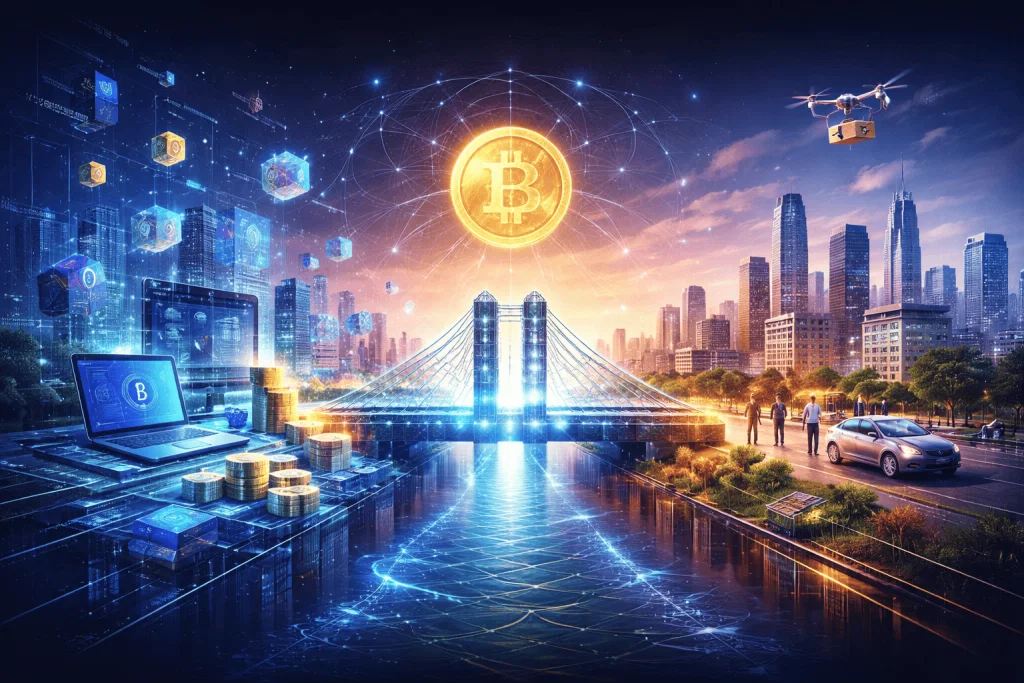
A major breakthrough in blockchain’s evolution is its ability to connect digital systems with physical, or real world, assets. The term Real World Asset refers to traditional financial or physical assets such as property, bonds, commodities, or fine art that are represented on a blockchain. This process is known as tokenization. Tokenization bridges the gap between the abstract digital world and tangible economic value by creating digital tokens that correspond to ownership rights in real assets.
For example, a piece of real estate can be tokenized into many smaller units, each representing a fraction of ownership. Instead of purchasing an entire property, investors can buy a portion — much like buying shares of a company. Tokenization thus democratizes access to assets that were previously out of reach for many individuals. It enables fractional ownership, reduces entry barriers, and increases liquidity for assets that historically were difficult to trade, such as high value property or collectibles.
Tokenization also creates global access. An investor in one country can participate in markets across the world without the need for complex intermediaries or cross‑border friction. The blockchain serves as a borderless infrastructure that supports ownership verification, settlement, and transfer using code. This capability can reshape investment landscapes and create new avenues for capital formation and distribution.
How Blockchain Enhances Asset Management?
Blockchain’s potential to improve asset management revolves around a set of core benefits that address persistent pain points in traditional systems. One of the most significant is transparency. On a blockchain, records of ownership and transactions are verifiable by anyone with access to the network. This visibility reduces disputes, fraud, and information asymmetry. Instead of relying on a central registry or custodian, participants can independently confirm the status of assets.
Blockchain can also lower costs by eliminating or reducing the need for intermediaries. Middlemen such as brokers, settlement agents, and custodians play crucial roles in current markets, but they also add layers of cost and complexity. By enabling direct peer to peer interaction, blockchain can automate many aspects of asset transfer and settlement, reducing fees and processing times.
Traditional financial markets are often constrained by slow settlement cycles. A transaction that might take days to clear can settle in minutes or even seconds on a blockchain. This acceleration improves capital efficiency and reduces counterparty risk — a major benefit for markets such as bonds, commodities, and private equity.
In addition, fractional ownership made possible by tokenization encourages broader participation. Investors with limited capital can acquire shares in high value assets without the need to commit large sums. This not only democratizes investment opportunities but also increases liquidity by turning previously illiquid assets into tradable units.
Practical Use Cases Across Industries
Blockchain’s real world applications extend far beyond theoretical concepts. Today, industries are experimenting with, and in some cases already adopting, blockchain based solutions that enhance efficiency and create new value.
In supply chains, blockchain enables end to end tracking of goods, from origin to delivery. With blockchain, each stage of a product’s journey can be recorded immutably, helping businesses ensure authenticity, prevent fraud, and comply with regulatory requirements. For consumers, this means greater confidence in product provenance and quality.
In healthcare, blockchain can securely store patient records and control access permissions. Traditional health records are often fragmented across systems, raising concerns about data security and continuity of care. Blockchain’s decentralized design allows shared access while maintaining patient privacy and data integrity. This results in better coordination between healthcare providers and safer, more efficient care delivery.
In the financial sector, blockchain accelerates and simplifies cross border payments, automates trade settlements, and enables smart contracts that execute business rules automatically. These innovations reduce dependence on legacy infrastructure, cut costs, and lower the barriers to financial services.
Government agencies and public institutions are also exploring blockchain for secure record keeping. Land registries, identity systems, voting records, and public documents can benefit from blockchain’s transparency and tamper resistant features. By keeping records on a distributed ledger, governments can reduce fraud, increase public trust, and make services more efficient.
Challenges Still Facing Blockchain Adoption
Despite its potential, blockchain technology is not without obstacles. One of the most persistent challenges is scalability. Public blockchains, in particular, struggle to handle large volumes of transactions at speeds comparable to traditional centralized systems. While newer consensus mechanisms and layer two solutions are improving performance, scalability remains a technological hurdle.
Regulation is another major challenge. Laws and policies governing digital assets and blockchain applications are still evolving in most countries. Uncertainty around compliance, taxation, and legal recognition of blockchain records can slow adoption. Regulatory environments that are ambiguous or hostile can deter businesses and investors from fully embracing blockchain solutions.
Energy consumption is also a concern, particularly for proof of work blockchains. These networks require significant computational power, which translates into high energy use. While alternatives such as proof of stake and other consensus mechanisms reduce energy requirements, many blockchain networks still need to improve their sustainability profiles.
User education remains a barrier as well. Blockchain concepts can be complex and intimidating for people unfamiliar with decentralized systems. Bridging this knowledge gap is crucial for broader adoption, as stakeholders need to understand not just what blockchain can do, but how to build and maintain systems that leverage its capabilities effectively.
The Future Of Blockchain Is Promising
Despite these challenges, the future of blockchain looks bright. As the global economy becomes increasingly digital, the value of trust and transparency rises with it. Blockchain provides tools that embed these qualities into core systems rather than relying on external enforcement.
Integration with fields such as tokenization of real world assets, decentralized finance, identity systems, and supply chain transparency is already underway. As more sectors realize the benefits of blockchain beyond buzzwords, adoption will continue to grow. This shift will empower individuals and organizations to interact in ways that are faster, more secure, and more inclusive.
Conclusion
The concept of buying property, investing in bonds, or trading commodities via a blockchain transaction — secure, transparent, and nearly instantaneous — is no longer futuristic. Such capabilities are quickly becoming tangible and practical. Rather than being a short lived technology trend, blockchain represents a foundational shift in how information is recorded, transferred, and trusted.
In the long run, blockchain will not replace traditional systems entirely but will augment them. The future of value creation, exchange, and verification is likely hybrid — blockchain integrated with legacy infrastructure and supported by clearer regulations and broader understanding. As innovations continue, blockchain’s reach will expand, bringing greater trust and efficiency to systems that underpin the global economy.