Introduction
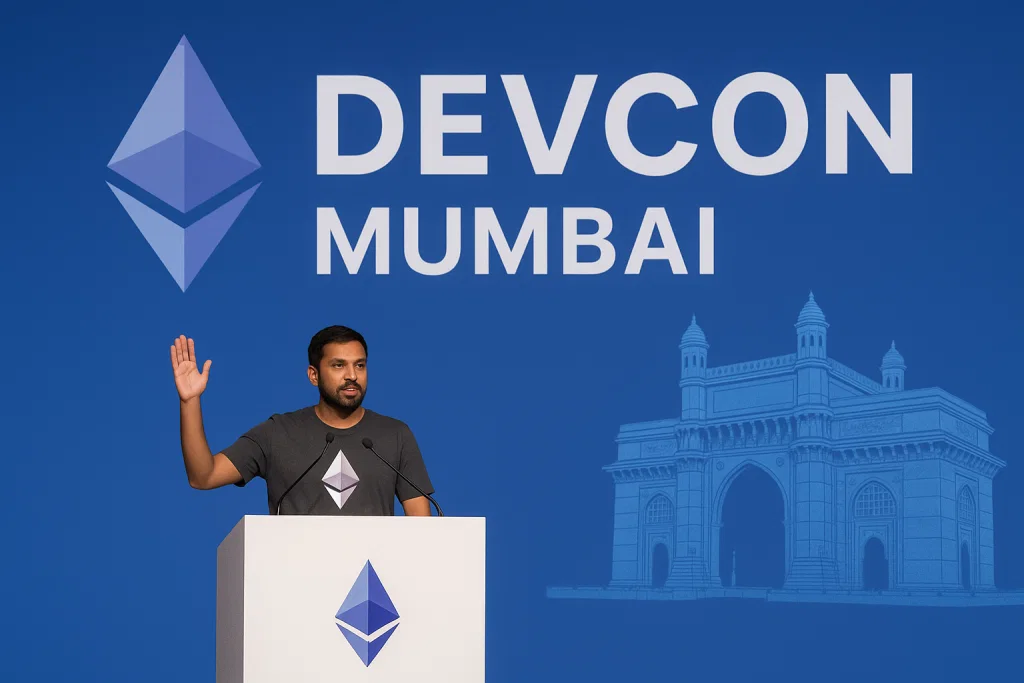
In a moment that has sent ripples across the global blockchain ecosystem, the Devcon 8 conference in Mumbai became the stage for a bold and historic announcement by the Ethereum Foundation. What began as an internal reckoning with issues of racism and inclusion within cryptocurrency circles morphed into a strategic pivot—one that places India firmly at the heart of Ethereum’s future trajectory. This article delves into how racism gained focus, how the announcement came about, and why this shift matters not just to India but to the entire Ethereum ecosystem.
A Moment Of Reckoning: Racism In Crypto And Ethereum
The cryptocurrency world often presents itself as a borderless, meritocratic realm—code and protocol rather than skin colour, geography or demographic background. Yet beneath the open-source ideal lies the reality of human networks, biases, and cultural blind spots. Within Ethereum’s global community, anxieties have simmered around under-representation of certain regions, unequal access to infrastructure, and token-distribution practices shaped by legacy networks.
At Devcon 8, organisers from the Ethereum Foundation acknowledged that the community’s failure to properly address racism—both structural and interpersonal—had created a credibility gap. While code may be agnostic, the social structures around it are not. This recognition proved important: by publicly acknowledging the issue, the Foundation signalled that Ethereum’s values extend beyond simply decentralised technology—they also involve equitable access, global participation and cultural respect.
In this context, the announcement made at Devcon 8 was not merely symbolic. It represented a deliberate attempt to address one of crypto’s deepest challenges: ensuring that the next wave of blockchain adoption isn’t concentrated in a few geographies but is truly global—and inclusive.
Why Mumbai, Why India, And Why Now?
Choosing Mumbai as the venue for this announcement was strategic on multiple levels. India today stands at a crossroads in blockchain adoption. With its large, tech-savvy population, growing developer ecosystems, and ambitious digital-economy goals, India presents one of the most fertile grounds for blockchain innovation.
Moreover, the timing is apt. Global regulators are refining crypto policy, investor appetite is shifting from speculation to real-world utility, and regions outside North America and Europe are clamouring for representation. For Ethereum, positioning India as a central participant sends a message: the future of web3 is not West-centric.
By making the announcement in Mumbai, Ethereum also acknowledges the geographic imbalance in prior events. Previous flagship conferences and ecosystem investments skewed Western. Bringing Devcon to India—and tying it to a broader anti-racism and inclusion narrative—serves as both a course-correction and a visible commitment to change.
The Historic Announcement: What Was Declared?
At Devcon 8, the Ethereum Foundation unveiled a multi-pronged initiative centered on India. While full details are yet to roll out, the key components of the announcement include:
India-First Developer Fund – A new grant program focused exclusively on Indian developers, startups and research institutions working on Ethereum SDKs, roll-ups, and decentralised applications tailored to local contexts (language, regulation, on-chain identity).
Women & Under-represented Builders in Blockchain Programme – Recognising that racial issues intertwine with gender and social equity, this programme aims to support builders from historically marginalised communities in India (and potentially South Asia).
Infrastructure Node Hubs – Establishing regionally distributed node-infrastructure hubs across India to reduce latency, improve access, and diversify the network beyond incumbents in North America / Europe.
Community Governance Expansion – A plan to deepen Indian representation within Ethereum’s global governance structures: more seats, more voice, more decision-making at scale.
Annual Asia-Pacific Ethereum Conference Track – Building up the Mumbai/India event into a recurring regional flagship for Ethereum, with local tracks, research symposia and ecosystem showcases.
The framing of the announcement made clear that this was not a temporary “India experiment”, but a long-term commitment. The word “historic” was used by several speakers—not as hyperbole, but as acknowledgement that seldom has Ethereum explicitly tied an anti-racism narrative to a geographic pivot of this scale.
Why Racism Became A Catalyst Rather Than Just A Sidebar?
Why did racism—and rather than simply economics or technology—act as the trigger for this announcement? Several reasons converge:
Credibility and community legitimacy: For Ethereum’s global brand, remaining silent on equity issues risked undermining its values. A public acknowledgement allowed the Foundation to align its messaging with broader social expectations.
Talent access: By addressing systemic biases, such as barriers to entry for non-Western builders, Ethereum can tap into a broader talent pool—crucial for maintaining innovation leadership in a competitive landscape.
User adoption: Many potential users and developers in India and similar markets feel overlooked by Western-centric crypto narratives. A clear inclusion-driven pivot helps bridge the gap between promise and presence.
Network resilience: Decentralisation isn’t just about technology—it’s also about distribution of power. By curbing geographic concentration of nodes, decision-making and ecosystem resources, the network becomes more robust and democratic.
In short, racism—or perhaps more precisely, inequity and exclusion—was not the sole issue, but it acted as a prism through which other structural fractures in the ecosystem became visible. By confronting those, Ethereum’s announcement hopes to deliver a more sustainable and globally-distributed future.
The Indian Ecosystem: Opportunities And Challenges
While the announcement is bold, execution in a complex market like India comes with its own hurdles. Consider the following:
Opportunities
India has one of the world’s largest concentrations of software engineers, many of whom are already familiar with open-source ecosystems and could pivot into blockchain.
The Indian government’s push toward digital public infrastructure (DPI), such as identity frameworks and digital payments, opens synergies with decentralised infrastructure.
A young population, increasing mobile connectivity, and growing web3 literacy make India a fertile field for non-financial use-cases (e.g., supply chain, digital rights, gaming).
Local language diversity encourages building solutions that don’t assume English-fluency, reducing barriers to mass adoption.
Challenges
Regulatory uncertainty: India’s crypto policy remains in flux, with taxation, licensing and consumer-protection issues still being debated.
Infrastructure gaps: Although urban hubs are strong, many regions face connectivity and access constraints that could hamper decentralised node-deployment or community development.
Cultural adaptation: Crypto and Ethereum ecosystems often assume Western norms in terms of community structure, developer practices and business models. Localising that mindset takes effort.
Competition: Other blockchain protocols are also eyeing India. Ethereum will need to move beyond symbolic announcements to tangible value to maintain leadership.
Implications For The Global Ethereum Ecosystem
While the announcement is India-focused, its implications extend far beyond. Here’s how it affects Ethereum worldwide:
Decentralisation of power – Historically, major Ethereum events, development hubs, protocol discussions and ecosystem funding have centred in North America, Western Europe and parts of East Asia. By shifting to India, the network reduces its structural bias toward Western geographies.
Developer diversity – Broadening the pool of contributors helps avoid monocultural innovation. New perspectives lead to novel applications and use-cases that might otherwise be overlooked.
Market diversification – As adoption deepens in India, Ethereum becomes less dependent on speculative flows from traditional markets and more rooted in real-world utility and user base.
Competitive defence – Other blockchain networks are aggressively pursuing emerging-market ecosystems. Ethereum’s stronger early positioning in India helps it defend market share and retain network effects.
Governance evolution – Empowering non-Western communities in decision-making may shift governance dynamics. This could lead to new priorities (local identity, scaling for developing markets, multilingual developer tools) being baked into the protocol roadmap.
In effect, this isn’t just India’s moment—it may mark a turning point in Ethereum’s evolution from a primarily Western-driven network to a truly global one.
What To Watch For Next?
Execution will matter more than announcement. The following are key metrics and milestones to monitor:
Grant deployment and uptake: How many Indian projects receive funding, what kinds of solutions they build, and how they integrate with the broader ecosystem.
Node infrastructure roll-out: Desktop vs cloud nodes; decentralised vs centrally hosted; latency and uptime improvements in the Asia-Pacific region.
Developer participation growth: Changes in metrics such as commits from Indian developers, number of Indian teams in hackathons, and representation in governance councils.
Regulatory clarity: How Indian authorities respond to this announcement—do they view Ethereum as a partner or a competitor? Changes in licensing, frameworks, and government-blockchain cooperation will matter.
Ecosystem health: Are local applications being built (not just “India versions” of Western apps), is there community growth, localisation, and meaningful usage?
Global shift signals: Will Ethereum announce similar regional pushes in Africa, Latin America or Southeast Asia? Or is India a unique one-off?
Conclusion
The Devcon 8 announcement in Mumbai signifies a critical juncture for Ethereum. By explicitly linking racial equity, geographic inclusion and ecosystem strategy, the Ethereum Foundation has moved beyond symbol into structural change. For India, it offers a pathway into the heart of the blockchain universe. For Ethereum, it opens new frontiers of growth, diversity and resilience.
Whether this moment proves transformative will depend not on rhetoric but on delivery: funding reaching indigenous builders, infrastructure being localised, governance expanding, and real-world applications emerging. But the signal is clear—blockchain cannot afford to be Western-centric if it hopes to fulfil its global promise.