Introduction
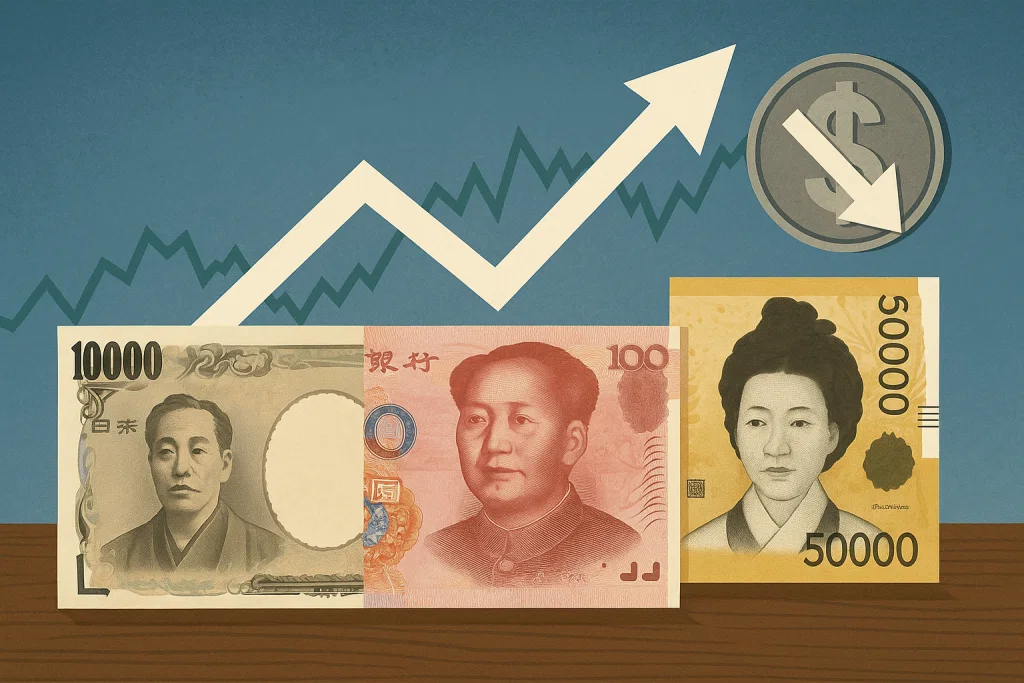
As June concludes, global currency markets are witnessing a notable shift in sentiment driven by divergent economic signals from the East and West. Asian currencies are staging a firm rebound as the latest Chinese PMI data reveals stronger-than-expected economic expansion. In contrast, the U.S. dollar finds itself on shaky ground, burdened by intensifying market speculation that the Federal Reserve may be approaching a rate-cutting cycle sooner than previously anticipated.
This macroeconomic backdrop, shaped by improving Asian fundamentals and softening U.S. economic momentum, is stirring a new narrative in the forex landscape. Investors are recalibrating their positions, realigning portfolios, and bracing for volatility as central banks pivot from tightening to stimulus. The interdependence of global economies and the fragile nature of recovery post-pandemic only add complexity to currency valuation forecasts.
Chinese PMIs Signal Economic Momentum
China’s June 2025 PMI data surprised markets with a strong rebound, marking the highest readings seen in over a year. The official manufacturing PMI rose to 51.8, comfortably above the 50-mark that signals expansion and beating analysts’ forecasts of 50.6. Meanwhile, the non-manufacturing PMI, which includes the services sector, climbed to 54.2, reflecting robust demand in services and consumer sectors.
This resurgence in activity comes after months of mixed signals from the Chinese economy, which has struggled to maintain consistent post-pandemic growth amid global trade tensions, supply chain disruptions, and internal property market stress. The latest figures suggest that recent fiscal and monetary support measures may finally be taking effect, with infrastructure investments and local government incentives helping to stabilize the economic base.
The strength of the PMI readings not only reflects real economic improvement but also serves as a psychological anchor for regional markets. Investors have responded positively, with capital flows returning to Asian equities and currency markets amid renewed confidence in the region’s growth potential.
Asian Currencies React Positively To Chinese Growth Data
The immediate impact of the Chinese PMI surprise was felt across major Asian currencies. The Chinese yuan, which had been trading with a cautious tone amid concerns over capital outflows and geopolitical uncertainties, rallied on the news. Offshore yuan (CNH) climbed to its strongest level in four weeks against the U.S. dollar, briefly touching 7.12 before settling around 7.14.
The Japanese yen also advanced modestly, helped by haven demand and the declining U.S. yield curve. Despite Japan’s own subdued inflation and monetary stance, the yen’s correlation with Chinese sentiment and its role as a risk barometer helped drive gains.
Elsewhere in the region, the South Korean won, Singapore dollar, and Malaysian ringgit all strengthened. The South Korean won appreciated nearly 0.8% intraday, buoyed not only by China’s data but also by signs of tech sector recovery and stabilizing chip exports. The Indonesian rupiah and Thai baht also posted gains, supported by firm commodity prices and improved investor sentiment toward emerging markets.
Market participants interpret the Chinese PMI uptick as a harbinger of improved trade flows and regional demand, which disproportionately benefits export-oriented economies like South Korea, Taiwan, and Singapore. Currency traders are quick to price in such shifts, especially when they align with a softening dollar.
U.S. Dollar Weakens Amid Fed Rate Cut Speculation
While Asia finds a growth narrative to celebrate, the United States is facing increased economic ambiguity. Recent U.S. macroeconomic releases, including softer-than-expected consumer spending data and downward revisions to Q1 GDP, have reignited speculation that the Federal Reserve may be closer to easing monetary policy than previously thought.
Fed Chair Jerome Powell’s latest remarks at the June monetary policy forum acknowledged that inflation is indeed slowing, and labor markets are beginning to show signs of moderation. Though Powell stopped short of committing to a timeline for cuts, traders interpreted the shift in language as dovish.
Fed fund futures markets are now pricing in a 60% chance of a rate cut at the September 2025 meeting, a marked increase from just 30% a week ago. The CME FedWatch tool has become a key guide for market sentiment, and its shift reflects growing investor consensus that the Fed may preemptively act to avoid a hard landing.
The result has been pronounced dollar weakness. The U.S. Dollar Index (DXY) fell below 103 for the first time in over a month, marking a weekly decline of nearly 1.2%. All major currencies gained against the greenback, with EUR/USD rising above 1.0950 and GBP/USD testing 1.2750. The pressure is even more acute in the Asian session, where risk appetite is stronger and rate divergence themes are particularly potent.
Central Banks’ Divergent Paths Reinforce FX Volatility
The diverging trajectories of monetary policy between the Federal Reserve and Asian central banks are reinforcing the current moves in FX markets. The People’s Bank of China (PBoC), which has maintained a more accommodative stance in recent months, now finds itself with optionality. Stronger domestic data gives Chinese policymakers room to slow down further stimulus and allow market forces to shape the yuan more organically.
Meanwhile, central banks in South Korea and India are adopting a more neutral tone, with inflation risks contained and external balances improving. The Reserve Bank of Australia and Bank of Japan remain in ultra-cautious territory, but even they are expected to shift tone in response to regional recovery.
In contrast, the Fed’s potential pivot from hawkish to dovish policy, especially without a formal recession trigger, is adding volatility to global FX markets. Traders are now dissecting every U.S. data release for signs that the Fed might confirm a shift, leading to outsized reactions in interest rate-sensitive currencies like the yen and Australian dollar.
Implications For Traders And Investors
The short-term implications of these developments are substantial. Traders with exposure to Asian currency pairs are finding opportunities in both spot and derivative markets. Long positions on emerging Asian currencies, such as the Thai baht or Indonesian rupiah, are now favored by macro hedge funds seeking to capitalize on the Fed’s dovish tilt and Asia’s growth momentum.
On the equity side, the stronger FX backdrop could support valuations for Asia-based multinationals, particularly exporters and commodity producers. This shift may also re-ignite carry trade strategies, as traders borrow in low-yield currencies like the yen to invest in higher-yielding Asian debt.
For long-term investors, this divergence between Asia and the U.S. is creating structural opportunities in portfolio rebalancing. FX-hedged instruments are increasingly in demand, and currency-adjusted bond returns are now back in focus. Institutional flows, particularly into China and South Korea, have begun to pick up, suggesting a broader asset allocation shift toward Asia is underway.
The Path Forward: Risks And Watchpoints
Despite the current optimism in Asia, several headwinds remain. Geopolitical tensions, particularly between China and Western economies, could limit foreign direct investment and complicate long-term capital flow trends. The property market in China, while stable for now, remains a significant overhang on consumer and investor confidence.
Moreover, if the Fed’s expected pivot does not materialize — for example, if inflation proves sticky or geopolitical shocks boost commodity prices — the current FX trends may reverse sharply. In that scenario, emerging markets could face outflows, and the dollar could reassert dominance, especially if yields spike.
Currency intervention is another wildcard. Asian central banks are known to intervene in markets to manage excessive currency volatility, particularly if appreciation threatens export competitiveness. Any such intervention could limit gains in regional currencies, despite positive macro data.
Conclusion
The synchronized rebound in Asian currencies following upbeat Chinese PMI data and the weakening U.S. dollar driven by expectations of a Fed rate cut marks a significant inflection point in global currency markets. These developments underscore the importance of economic divergence in shaping FX trends, particularly in a global economy still recalibrating after years of aggressive monetary tightening.
While the immediate momentum favors Asian currencies and highlights growing investor confidence in the region’s economic outlook, caution remains warranted. Ongoing geopolitical tensions, uneven recovery paths, and central bank unpredictability continue to cloud the horizon.
Nevertheless, this episode serves as a compelling case study of how macroeconomic indicators — when aligned with policy expectations — can quickly reshape global capital flows. For forex traders, institutional investors, and policymakers alike, the evolving Asia–U.S. currency narrative will remain a focal point in the second half of 2025 and beyond.